 Skip to content


In a Startup, How Do Shares, Equity, and Dilution Really Work?
16th February 2023
Fundraising is difficult. That’s why, on average, only 1% of startup founders manage to successfully close their deals.
If you want to be in that elite 1%, you must understand the finer details of raising investment. One of the essential parts of that understanding is knowing what shares, equity and dilution are and how they work. You’re going to come across these terms a lot as a startup founder and if you don’t have a handle on them it can feel a lot like being thrown in at the deep end.
Related: Protect Your Equity: The Smart Approach to Winning Early Stage Investment
The part that shares and equity play in a startup.
Important Definitions
First, let’s define exactly what we mean by the terms that will be used in this article. You might not want to read this now, but refer back to it as you read the rest of the article.
- Equity represents ownership in a company. When founders, employees, or investors hold equity, they essentially own a portion of the business, typically in the form of shares.
- Shares are the units that represent ownership (equity) in a company. Each share provides a stake in the business, and the total number of shares determines how equity is divided among shareholders.
- Common Stock is typically held by founders and employees. It often comes with voting rights, allowing holders to influence company decisions, but it ranks lower in priority for dividends and liquidation.
- Preferred Stock: Usually reserved for investors, preferred stock grants additional privileges, such as priority on dividends and liquidation rights. It often carries limited or no voting power but protects investors’ financial interests more strongly than common stock.
- Dilution occurs when a company issues new shares, reducing the ownership percentage of existing shareholders. Although their ownership percentage shrinks, the overall value of the company may increase through additional investment.
- Types of Shares (Class A, B, C): Different classes of shares can be issued to distinguish between varying levels of control and financial benefits. For example, Class A shares might offer enhanced voting rights, while Class B or C shares may limit voting power or offer different dividend structures.
- A cap table is a document that outlines the ownership structure of a company. It lists all shareholders, the type and number of shares they own, and the percentage of total equity they control.

Shares are units of equity. Every limited company has shares, and it is these shares that are bought by investors. The more shares the investor owns, the more equity they control. For an overview of how equity could be divided between founders and investors, take a look at this advice on Entrepreneur.com. It’s an old article, but it’s full of up-to-date common sense.
Let’s say your startup has one hundred shares and you have all one hundred of them. That means you own 100% of your startup’s equity. However, if you only have fifty shares, and an investor has the other fifty, you each own 50% of the company.

Most startup founders think that, when the time comes to sell equity in their company, it’s going to be a straightforward transaction. All they’ll need to do is take an agreed number of their shares—for example, 15 of the 100 shares the company has – and transfer them to an investor in return for cash. In that scenario, the investor would now own 15% of your startup’s equity and you would own the remaining 85%.
Unfortunately, it’s not as simple as that. In practice, what usually happens is that the company will create more shares to sell to the investor. So, in the above example, the startup founder would retain their original one hundred shares, but they’d create 18 new shares for the investor to buy. This means the investor would now own 18 of the startup’s 118 shares, which is equal to 15%.
DOWNLOAD: Startup Equity Dilution Calculator
What happens when you dilute your startup’s equity?

Dilution is what happens when you and your investor’s total equity in the startup gets smaller each time new shares in the company are created and issued. This happens at every fundraising round (as well as other events such as bringing on board co-founders, or setting up an options pool) and it’s a concept that many startup founders struggle to understand.
READ: What Are Share Options? A Startup’s Guide to How Shares Work
Let’s fast forward to the second fundraising round. You previously created the 18 new shares for your investor, so your total shareholding is still one hundred, but your equity has reduced to 85% and the investor holds 18 shares, so their equity is 15%.
Now you’re doing a second fundraising round, your first investor’s equity is going to get diluted.
So is yours.
And this is how.
Let’s say you’ve succeeded in the second fundraising round, but this time you’ve agreed to sell your second investor 20% equity in your startup in return for their investment. Following on from the previous example, this means you’d need to create a further 29 shares.
The result? Your company would have a new total of 147 shares. You would still own one hundred shares, your first investor would still own 18, and now your second investor owns 29. The second investor’s equity is 20%, but what’s happened to your first investor’s equity?
What’s happened to your first investor’s equity is that their share in your company has shrunk. Although they still own 18 shares, 18 shares out of the new total of 147 shares is 12%. In other words, after the second round, your first investor has gone from owning 15% of your startup to owning just 12%.
As a founder, your shares have shrunk too. You fell from owning 100% to 85% and now, after the second round, you own 68%.
That’s what dilution is, and that’s why investors get concerned about it, because for every round of investment you successfully complete, their overall share of your company will get smaller.
READ: Sweat Equity – The Dangers of Giving up Too Much Equity Too Soon
Strategic considerations around dilution
Dilution is inevitable when raising equity investment, but that doesn’t mean founders should simply accept it without question. Understanding how to strategically manage dilution can be the difference between maintaining control and watching your ownership slip away with each new round of funding. Here, we explore some critical tactics to protect founder ownership, the dangers of down rounds, and alternative fundraising methods that offer flexibility.
Protecting founder ownership
Dilution doesn’t have to mean losing control of your company. Savvy founders know that negotiating for better terms early on can save a great deal of equity later. One common tactic is to create an options pool – a portion of shares set aside specifically for future hires, ensuring you can attract talent without constantly eroding your own stake in the business. Equally, it’s wise to negotiate valuation and terms that protect you from excessive dilution: a smaller round at a higher valuation may seem like the obvious choice, but it’s not always about the cash – sometimes it’s about the terms that come with it.
Another strategy is founder vesting, where your shares are tied to performance milestones. This prevents over-dilution at early stages, as you retain equity through tangible results. Be aware that investors may push for more aggressive terms, but this is where your negotiation skills come into play. Founders who understand the importance of future-proofing their ownership tend to fare better as the rounds progress.
Down rounds and their impact
Now, here’s something founders dread: a down round. When a company raises money at a lower valuation than in a previous round, it can spell disaster – not just for the founder’s equity, but for relationships with early investors. Down rounds send a message that the company’s growth has stagnated or regressed, which can damage credibility and investor confidence.
Worse still, the impact on dilution is brutal. Early investors who once held a significant share may find themselves losing equity faster than they anticipated. This is why it’s so important to manage expectations and have a clear plan for how you’ll navigate tough financial times. Down rounds can lead to harsher terms from new investors – anti-dilution provisions are often triggered, which can further dilute founders and existing shareholders. So, it’s crucial to avoid them where possible or manage them effectively if unavoidable.
There’s a strange duality to down rounds: while they’re often seen as a failure, they can also be a necessary evil to keep the company alive. The key is to be transparent with your investors – explain how the new capital will drive future growth, and be ready to justify why you’re still worth investing in. Managing a down round with grace and foresight can prevent a cascade of negative consequences.
Convertible Notes and Advanced Subscription Agreements (ASAs)
For UK founders aiming to delay dilution, convertible notes and Advanced Subscription Agreements (ASAs) offer flexible options. These mechanisms allow you to raise capital now without issuing new shares immediately. Instead, the investment converts into equity at a future event, such as hitting a valuation milestone or closing a future funding round.
Convertible notes function as loans that later convert into equity, often with a discount for early investors. ASAs are similar but differ in that they are purely an equity-based agreement, without the loan aspect, where investors commit funds now with the expectation of receiving shares in a future round. The advantage of both is clear: founders can secure funding without giving away equity too early, before the company has reached its true value.
However, these instruments come with considerations. Investors may feel uneasy about delayed equity conversion, and if future rounds don’t materialise as expected, conversion terms may become less favourable than anticipated. Timing is essential—waiting too long to trigger conversion could lead to unexpected dilution.
In the UK context, both options offer valuable flexibility, helping founders avoid early dilution and defer equity issuance until the business is more fully valued. Used wisely, they can support growth while protecting founder ownership for a little longer.
Is dilution always an issue for investors?

Not necessarily. If each round and each new investor increases your valuation, the company will eventually sell for a larger sum of money than it is worth prior to being diluted. As a result, you and your investors have a smaller share but of a larger value – so you’ll all still come out on top.
For example, if your startup was originally worth £1m and your original investor’s equity was 15%, the value of their shares would be £150k.
But…
If subsequent fundraising rounds increase your startup’s value to £10m but dilute your original investor’s equity to 12%, the value of their shares will have risen to an astronomical £1.2m.
Even though they lost equity, their investment has led to a much more awesome payday.
Shares, equity, and dilution are a massive deal for startup investors.
Demonstrating to potential investors that you understand what shares, equity and dilution are is as essential as showing them the three fundamentals they’ll expect to see from your financial projections.
They’ll be impressed when you do, because this isn’t the kind of information that’s taught in school. Not even MBA programs spend much time focusing on the details of equity investment.
Every prospective investor will want to know:
- you understand how many rounds of investment you’re planning
- how much equity you might consider selling in the future
- the implication both those decisions could have on the potential returns of their investment.
If you can reassure them as much as possible about your long-term plans, or at least show them you understand how raising more money in the future will impact their own shareholding, they’ll be much closer to wanting to invest in you.
Early-stage equity allocation advice
Many founders wrestle with the question of how much equity to give away in the early stages. There’s no perfect formula, but there are some principles to follow if you want to keep control of your company while attracting the right investors and talent.
Early rounds
In the first few rounds, it’s typical to give away anywhere from 15% to 25% equity to early investors. Pre-Seed rounds often fall toward the higher end of this spectrum, while a Series A is more likely to be at the lower end, and a Seed round somewhere in the middle.
But here’s the thing: it’s not just about the percentage, it’s about who you’re giving it to. Quality matters. You’re not just trading equity for cash; you’re trading it for expertise, mentorship, and strategic input.
You want investors who bring more than money to the table – people who can open doors or guide you through the tricky growth stages.
Keep ‘em lean
The reality is that equity will always get diluted as you raise more capital, but founders can protect their stakes by being shrewd from the outset.
One strategy is to keep early rounds as lean as possible, raising just enough to hit your next major milestone without giving away too much.
Another strategy is to carefully consider your valuation – don’t sell yourself short, but don’t be unrealistic either. The higher your valuation, the less equity you need to part with, but a sky-high valuation that’s not backed by real growth can lead to disastrous down rounds later.
READ: Protect Your Equity: The Smart Approach To Winning Early Stage Investment
Attracting talent
And then there’s the matter of talent. Early on, you’ll likely need to set up an employee stock options pool (ESOP). This is essential – good people are your most valuable asset, and equity is often the best way to attract and retain top talent without breaking the bank on salaries. But, again, it’s all about balance.
A typical ESOP allocation might be around 10-15%, reserved for key hires like early engineers or executives. You want to be generous enough to bring in the best, but not so generous that you find yourself losing control of your own company.
Structure the ESOP well
Managing the ESOP while keeping dilution in check is where many founders stumble. Too many options too soon can leave you with little left to offer in future, or worse, find yourself diluted beyond what you’re comfortable with. The key is to structure the ESOP wisely – vesting schedules, cliffs, and milestones can help ensure that employees earn their equity over time, aligning their goals with the long-term success of the business. For example, a typical vesting schedule might involve a four-year period with a one-year cliff, meaning that employees must stay for at least a year to earn any equity, after which their shares vest gradually over the remaining three years.
This way, you’re not handing out chunks of your company from day one. Instead, you’re ensuring that those who stick around and help you grow are rewarded proportionally to their contribution.
But beware: while setting up an ESOP can safeguard your ownership, it also opens the door to more dilution as your company expands. Founders who don’t plan for this can find themselves trapped – forced to raise more capital but with less equity to offer.
To mitigate this, some founders choose to keep a portion of their own shares in reserve for future hires or potential down rounds. It’s a long-term play, but one that can keep you in the driver’s seat as your company scales.
READ: How To Value Your Startup And Decide How Much Equity To Give Away
In the end, early-stage equity allocation is complex – one where each decision ripples out into your company’s future. It’s about being strategic, yes, but also realistic. You’re not just building a business; you’re building a team of people and investors who will be with you through the ups and downs. The goal is to keep enough equity to steer the ship, but give away enough to ensure you’ve got the right crew on board for the journey.
If you feel like diving deeper into the subject of equity and capital structure, this recent Forbes magazine article is an excellent place to start.
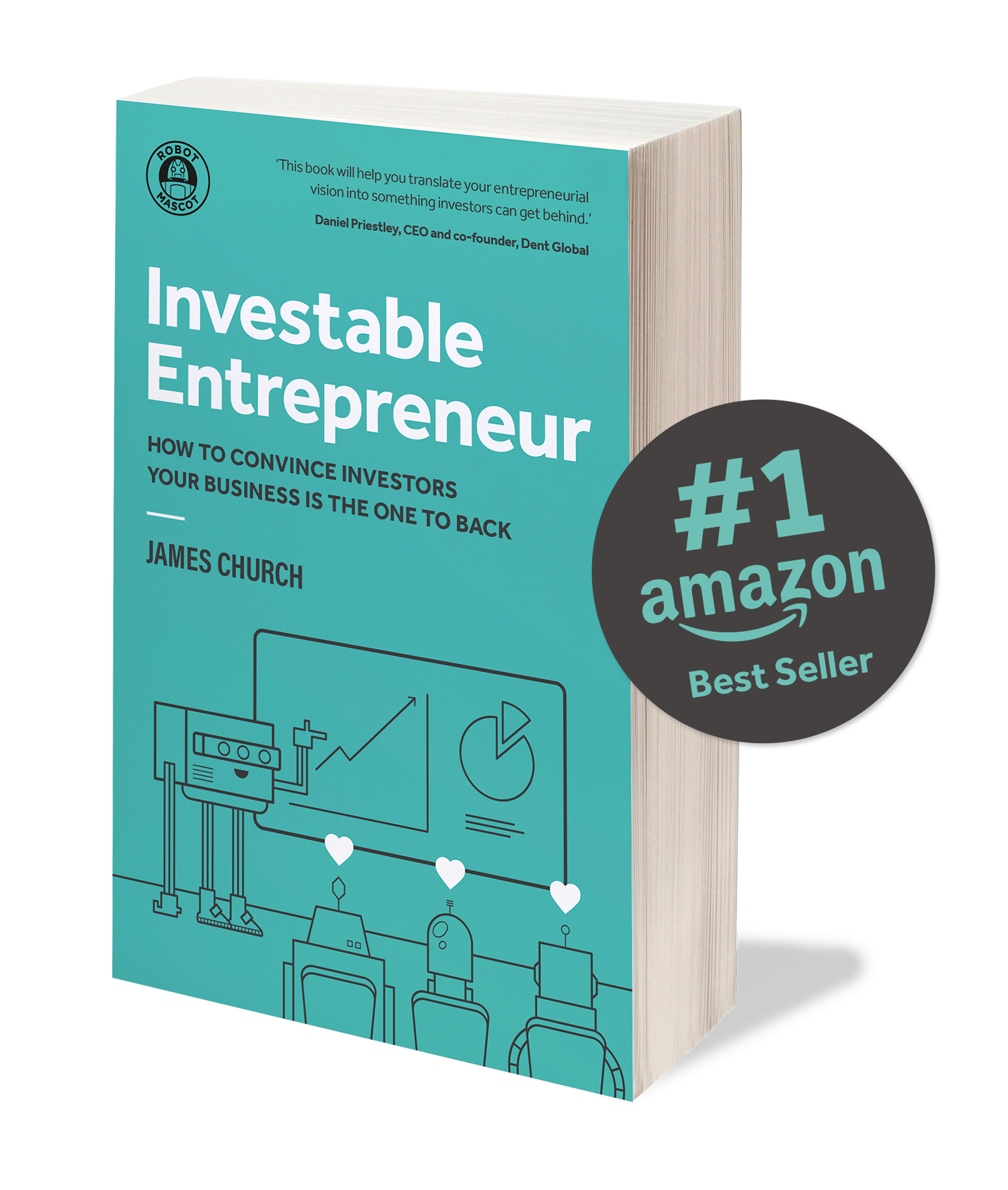
Meanwhile, to read more about becoming an ‘Investable Entrepreneur’, you can download a free copy of James Church’s bestselling book.
UP NEXT:
How to Create an Investment Pitch: The Three Vital Stages of Creating an Investment Winner
Your Weakness Can Be Your Biggest Strength
How Do You Know It’s the Right Time to Seek Startup Finance?

Learn how to convince investors
Investable Entrepreneur takes you through our winning methodology – the process we use to increase our client’s chances of raising investment by more than 30x.
“This book will help you translate your entrepreneurial vision into something investors can get behind.”
Daniel Priestley, CEO and founder, Dent Global and four times best-selling business author
Recent Posts


Keep up to date with what we’re up to via email





Copyright ©Robot Mascot Ltd. All rights reserved.
