 Skip to content


The Role of Storytelling in Pitching to Investor
9th October 2025
Pitching to investors isn’t just an exercise in reciting numbers and facts – it’s about communicating a vision through a captivating story. In an environment where investors review countless decks, a clear and compelling narrative can make the difference between securing funding and being overlooked.
A strong pitch tells the story of your startup: why it exists, the problem it solves, the journey so far, and the ambitious future ahead. This guide will walk you through why storytelling matters in investor pitches and how to craft a pitch deck narrative that resonates.
In this article, we’ll cover the importance of blending emotion with evidence, structuring your pitch like a story, and practical tips to make your story memorable.

Why storytelling matters in investor pitches

When investors are inundated with pitch decks, facts and figures alone often blur together, making it hard for any single startup to stand out. What sets apart a successful pitch is its ability to tap into the human element – engaging emotions and forging a connection. Simply put, people connect with stories before they connect with numbers.
Data and metrics are essential to back up your business case, but it’s the narrative underpinning those facts that grabs attention and stays in memory. In fact, research shows that stories are remembered up to 22 times more than facts alone, demonstrating the remarkable power of a good story to lodge in an investor’s mind.
CASE STUDY: Pitch Like a Pro: How Storytelling Turns Slides Into Funding
Emotional engagement is key
A well-crafted story elicits an emotional response, helping investors connect with your vision on a personal level. If you can make an investor feel the pain point you’re solving and share your excitement for the solution, your pitch becomes far more memorable. Investors are not purely analytical robots; they’re human beings who make decisions with both head and heart.
As one storytelling coach notes, even accomplished founders often forget to highlight their personal “why,” yet it’s the personal narrative that makes a pitch memorable and compelling, illuminating the journey that led the founder to the problem in the first place. By introducing a relatable human element – for example, the founder’s own experience with the problem – you trigger empathy and interest that pure numbers can’t achieve.
Clarity and understanding
Stories also bring clarity to complex ideas. Rather than bombarding listeners with technical jargon or intricate details, framing your startup’s mission within a narrative makes it easier for investors to grasp what problem you’re solving and why it matters.
A narrative gives context. It allows you to simplify without being simplistic: instead of just saying what your product does, you show why it exists through the storyline of a real-world challenge and solution.
This approach prevents the common pitfall of pitches that leave investors confused about the basics of the business. In fact, a lack of clear storytelling is often the biggest barrier to successful fundraising. Many founders have brilliant ideas but fail to articulate them in a clear, compelling manner; poor communication is killing some of the brightest business ideas. Investors can’t invest if they don’t understand what your business actually does or why it exists – a frustration echoed by over 80% of investors who say too many decks leave them guessing the fundamental story.
A strong narrative cuts through that confusion by guiding the investor through your logic in a coherent, digestible way.
READ: How To Structure A Pitch Deck
Building trust and credibility
A genuine story can also establish credibility and trust. When investors see the passion and motivation behind your venture, for example, that you lived the problem and felt compelled to solve it, they’re more likely to believe you have the conviction to execute your vision.
Storytelling allows you to subtly weave in your background and credentials in context. Rather than dryly listing your achievements or experience, you might share a brief anecdote within your origin story that demonstrates your expertise or resilience. This way, you boost your credibility organically through the narrative of your journey. Investors appreciate this authenticity; it feels more natural and convincing than a resume recital.
READ: How To Build Brand Credibility: 12 Tried & Tested Methods
Also, a narrative that highlights challenges overcome or lessons learned can humanise you in the eyes of investors. It shows humility and determination, which can help build trust. In summary, a pitch with a heart and a personality is far more compelling than a pitch that reads like a report. Indeed, veteran investors often say the number one thing they look for is clarity around the founder’s story and a compelling future vision – if they’re excited by your idea, if they “get” why you do it and see where you’re heading, you’ve got a great chance of securing their investment.
Crafting a compelling pitch narrative

So, how can you craft a story that captivates investors? It starts by thinking of your pitch not as a list of slides, but as a coherent narrative arc. Your pitch deck is not just a condensed business plan; it’s an opportunity to tell your story, articulate your vision, and explain why your business will be a big success. Here we break down the key elements of a compelling pitch narrative, essentially mapping out what to say and in what order to say it for maximum impact. Consider the following framework as you shape your story:
Start with the problem (and why it matters)
Every great story starts by setting the scene. In your pitch, begin by introducing the problem your startup is addressing. Make it visceral, relatable, and urgent.
One powerful approach is to share the inciting incident – the moment or experience that made the problem real to you as a founder. For example, you might briefly recount how you personally encountered the pain point or witnessed others struggling with it. (This could be a good place for a hypothetical anecdote inspired by real events – we’ll fictionalise to illustrate: “Two years ago, I watched my small retail business nearly collapse because I couldn’t track inventory efficiently. I wasn’t alone – thousands of shop owners faced the same issue.”
Though fictional, a scenario like this mirrors many founders’ reality.) By starting with a human-centred problem story, you grab the investor’s attention and empathy from the get-go. They should immediately appreciate the gravity of the issue and why it’s worth solving. Frame the problem in a way that highlights the pain point and its broader implications (e.g. “Millions of small retailers lose 10% of revenue to inventory errors each year”). This sets up the stakes and creates a sense of urgency.
Introduce your solution as the hero
Once the problem is crystal clear, present your startup as the hero of this story – the solution that will vanquish the problem. This is your moment to shine a spotlight on your product or service and how uniquely it addresses the pain point.
Explain succinctly what your solution is and how it fixes the problem. The goal is to make the investor think, “Aha, this founder has cracked it!” Keep it concise and focused on your unique value proposition – what sets your approach apart.
It can help to use simple, concrete terms rather than buzzwords. For instance, instead of saying “We leverage cutting-edge synergies to optimize supply chain workflows,” you might say “Our platform acts like a smart assistant for inventory – it automatically tracks stock in real time and alerts owners before they run out or overstock.” By speaking clearly and showing how your solution fits the problem, you make it easy for investors to grasp your idea.
Narrative tip: you might frame this part with a mini-story of discovery or innovation: “After that near-disaster with my shop, I envisioned a better way. I built a simple app prototype to track my stock – and it worked. Now we’ve developed it into a full platform that’s helping other shop owners avoid the mistakes I made.”
Such a narrative not only explains your solution but also highlights your personal drive and ingenuity.
Show the journey and traction
Every story has a middle – the journey of challenges and successes that brings the hero to where they are now. In your pitch narrative, take investors through your startup’s journey so far. How did you go from identifying the problem to developing your solution?
Share key milestones and achievements that validate your progress: perhaps you secured a pilot customer, built a working prototype, achieved a certain amount of revenue, or hit a product development milestone.
This part of the story demonstrates momentum and learning. It’s also an opportunity to quietly highlight your team’s capabilities and resilience. For example: “We spent six months iterating with 20 beta users, and their feedback helped us refine the product’s core features. Last quarter, those early adopters collectively saved £50k in inventory costs using our app.”
These kinds of details act as evidence within your story, showing that you haven’t just dreamed up a hero – you’ve actually put them on the field and they’re winning. If there were obstacles or pivots, you can mention them briefly to show you can adapt and persevere (investors appreciate a founder who can navigate adversity). By the end of this “journey” section, the investor should feel confident that your solution works on a small scale and that you have the right people and learnings in place to take it further.
In essence, you’re building the rising action towards the climax of your story – proof that the concept is valid and the venture is gaining traction.
READ: How to write investment winning content for my pitch deck
Emphasise the impact and future vision
Now it’s time for the big picture. Paint a vivid picture of the future with your solution at the centre. How will your startup change lives, industries, or communities once it scales? Show the potential impact in terms that matter – this could be market size and opportunity, social or economic benefits, or disruptive innovation. Investors want to know that backing you will yield significant returns or create meaningful change (preferably both). So, describe what happens when your hero succeeds on a grand scale.
For example: “If our inventory platform were adopted by small retailers across the UK, it could recapture an estimated £500 million in lost revenue for these businesses, effectively revitalising the high street retail sector.” This is where you connect your story to a vision that inspires investors.
It’s often effective to highlight the cost of “doing nothing” as well – the risk or loss that will persist if the problem remains unsolved. By contrasting that with the positive future you’re offering, you create a sense of opportunity and urgency. Keep this vision grounded with realistic growth plans (investors have keen BS detectors), but do convey ambition. You want them to see that investing in your startup could lead to a significant win – both financially and in terms of impact.
Essentially, you’re answering the question: “Why does this company matter, and why will it be big?”.
SERVICE: Develop Your Startup’s Long-Term Vision
End with a clear call to action (the ask)
Every good story needs a strong ending. In a pitch, that’s your call to action for the investors. After taking them through the narrative of problem, solution, journey, and vision, tell them exactly what you’re asking for.
This means clearly stating how much funding you seek, and for what – as well as what the next steps are. For instance: “We’re raising £1 million to expand our team and launch nationally, which will fuel the next 18 months of growth. We invite you to join us on this journey and help make inventory nightmares a thing of the past.”
Don’t be shy or vague here. A compelling story can stir an investor’s excitement, but you must direct that energy into action. Make it explicit what you need from them and why their involvement matters to your mission.
By the end of the pitch, there should be no doubt about what you’re asking and what the opportunity is. This final part of your narrative is where you convert storytelling into a business proposition – you’ve made them care, now make it clear how they can participate.
The outline above mirrors classic storytelling arcs (you might notice it follows a logical flow: context → conflict → resolution, with you as the protagonist). Many successful pitch decks use a similar flow, whether explicitly or subtly. The specifics can be adjusted for your startup, but as a rule of thumb, ensure your pitch has a beginning, middle, and end that correspond to setup, development, and payoff. One startup strategist neatly summed it up as a three-part framework: Problem, Solution, Impact – positioning your startup as the hero tackling challenges and delivering results. If you cover those bases, you’re telling a complete story.
Crucially, remember to hook your audience early. Both anecdotal wisdom and research suggest you have limited time (often only the first minute or less) to convince an investor to pay attention. Introduce your personal journey and the problem within the first 30-60 seconds, or as one guide puts it, hook them in the first 40 seconds. That means no long preambles or meandering backstory – jump right into the most gripping part of your story as soon as possible. You can always elaborate on details in the Q&A or later in the deck, but if you don’t spark interest immediately, you may not get the chance.
Fictional example (inspired by real pitches we’ve worked on): To see how this narrative flow comes together, imagine a founder opening her pitch like this:
| “A year ago, my father – a lifelong lorry driver – nearly fell asleep at the wheel and crashed. Why? Because of an undiagnosed sleep disorder. It turns out thousands of drivers are at risk every day due to undetected fatigue issues, leading to accidents on our roads. I’m Sarah, and I started SleepSafe to fix that. Our solution is a smart wearable that monitors truckers’ drowsiness in real time and alerts them before it becomes dangerous. We tested it with a major haulage firm, and in 3 months their fatigue-related incidents dropped to zero. Now, we plan to roll this out nationwide, potentially preventing hundreds of accidents and saving lives (not to mention millions in damages) each year. To do it, we are raising £2 million…” |
In this (fictional) pitch, the founder began with a personal, emotional story (her father’s near-miss) that illustrates the problem vividly. She then introduced her solution as the hero (a wearable device), provided evidence from a pilot (zero incidents in 3 months – a compelling metric), and painted the larger vision (safer roads, lives saved, cost savings). Finally, she made the ask. Even in a short span, she covered the key narrative beats in a way that’s easy to follow and hard to forget. Notice how the personal story made the problem tangible, and the use of a real outcome (though hypothetical here) gave credibility to her solution. This is the power of weaving storytelling into your pitch.
Structuring your pitch like a story

Just as important as what story you tell is how you tell it. A great narrative needs a good structure – a framework that ensures your message unfolds in a logical, compelling sequence. Rather than throwing together slides haphazardly or following a generic template blindly, think of your pitch in terms of story acts. In fact, pitching expert James Church suggests approaching your deck like a script or play: he advocates a five-act structure for the “perfect pitch”. Adapting a classic storytelling form (once beloved by Shakespeare and still used in films and theatre) helps create a pitch that flows with purpose and keeps investors engaged through each stage.
The Five Acts of the Perfect Pitch
- Act 1 – The Hook
- Act 2 – The Essence
- Act 3 – The Evidence
- Act 4 – The Plan
- Act 5 – The Ask
Find out more about the Five Act Structure in How to create a powerful investment pitch deck.
By structuring your pitch in these five acts, you ensure that you’re telling your startup’s story in the best possible light. It forces you to include the most compelling parts of your business case in each section, rather than following a one-size-fits-all template that might not suit your unique story. Importantly, this structure also mirrors the natural flow of a story: you hook the audience, set up context (essence), build tension with proof (evidence), provide resolution with a plan, and then urge action (ask). Investors subconsciously appreciate a well-structured narrative – it feels satisfying and complete.

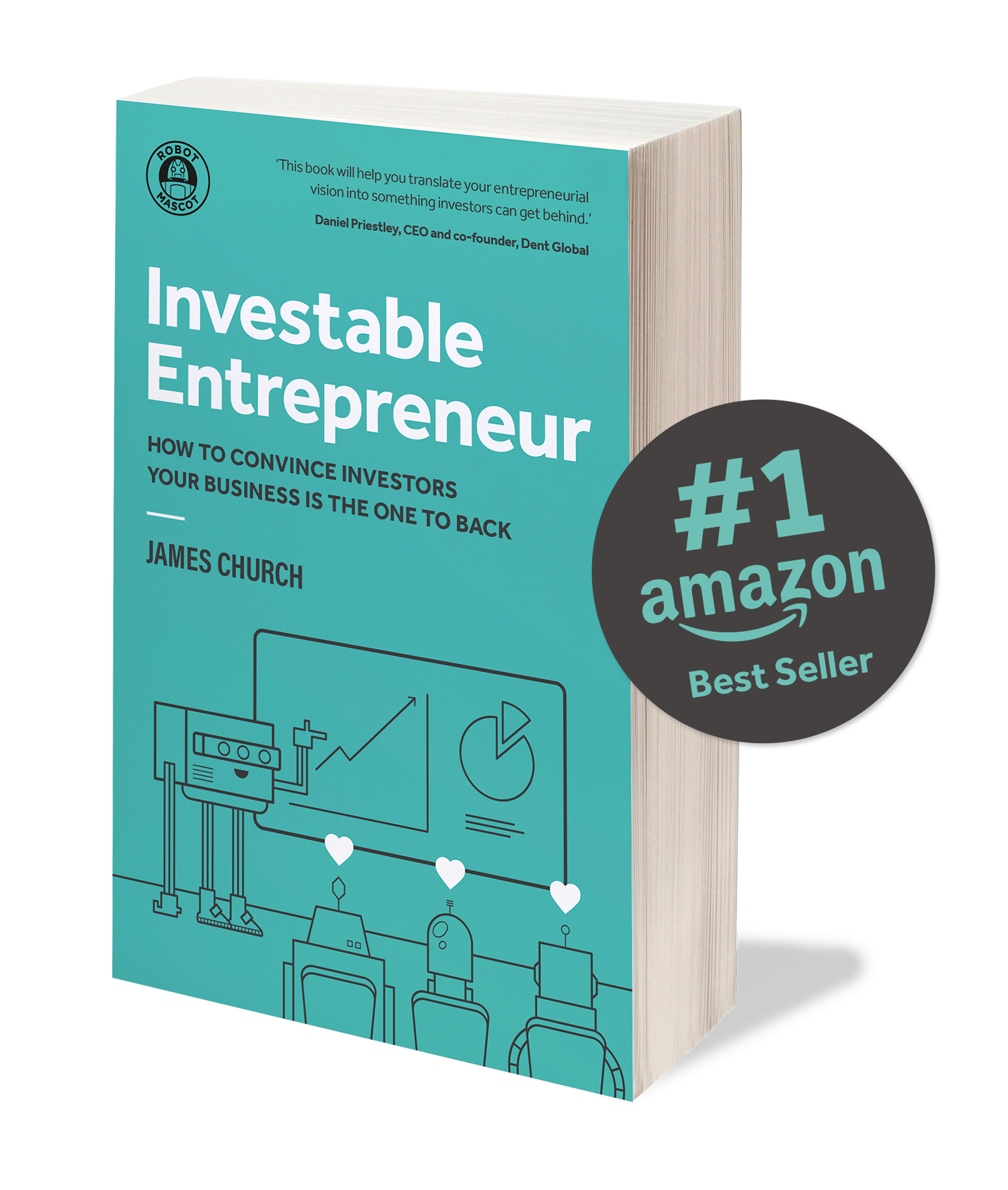
Claim your Free Copy of Investable Entrepreneur
Investable Entrepreneur takes you through our winning methodology – the process we use to increase our client’s chances of raising investment by more than 30x.
“This book will help you translate your entrepreneurial vision into something investors can get behind.”
Daniel Priestley, CEO and founder, Dent Global and four times best-selling business author
Recent Posts


Keep up to date with what we’re up to via email



Copyright ©Robot Mascot Ltd. All rights reserved.
