 Skip to content


What Is A Unicorn Company? What Makes A Billion-Dollar Business?
22nd February 2022
Many investable entrepreneurs dream of becoming a ‘unicorn’. Venture capitalist Aileen Lee first coined the term in 2013. At that time, there were only 39 unicorn startups. Today, there are more than 900 unicorn startups worldwide.
What is a unicorn?
A unicorn is when a startup reaches a valuation of $1 billion. These rare businesses achieve their status by disrupting industries, driving innovation, and scaling rapidly, often through groundbreaking technology or unique business models.
When it’s done well, it’s a Facebook, Google, or Airbnb. When it’s done badly, it turns into Unicorn Shit, like a WeWork or a Theranos. In other words, achieving unicorn-hood isn’t a solid gold guarantee of success. Still, it’s as close as any founder can hope to get (except for a couple of other unicorn species we’ll mention in a moment.)
Why have unicorns grown so fast?
In 2013, the world had just 39 unicorns—startups valued at $1 billion or more. By 2021, that number had skyrocketed to over 900, with new unicorns emerging across diverse industries and geographies. This explosive growth isn’t just a coincidence; it’s the result of several key trends and strategies that have transformed the startup landscape, making unicorn status more attainable than ever before.
From aggressive growth tactics like Blitzscaling to the rise of private capital investment, here are the main factors fueling the rapid rise of billion-dollar businesses.
The growth explosion of unicorns is attributable to several factors.
- The popularity of the Blitzscaling, or ‘Get Big Fast’ (GBF), strategy. This is when a startup tries to deter its rivals and gain a market share advantage through a focused combination of larger funding rounds and price cutting.
- Large companies focused on making acquisitions and buying out pre-existing technology and business models instead of investing in their own innovation.
- The increase in private capital investment.
- Not having to go through an Initial Public Offering (IPO) to obtain capital or higher valuation, which could potentially devalue the startup if the public market thinks the company is worth less than its investors do. A startup can avoid the IPO by simply going back to their investors and asking for more capital.
- The ongoing explosion in new and innovative technology that has allowed startups to upscale and expand faster than ever.
What are the most common traits of a unicorn?
Innovation
Unicorns tend to be innovators: they bring something so new and exciting to the market that it immediately establishes them as a leader in their field. Just as importantly, they never stop innovating. As a result, a unicorn always stays several steps ahead of its competitors.
Disruptors
They are disruptive in that they don’t stick to the rules of their chosen industry; they rewrite them. Disruption can take many forms, such as introducing a new business model (e.g., subscription services or gig economy platforms), redefining customer expectations (like Amazon’s focus on convenience), or leveraging technology to streamline inefficient processes (like Stripe’s payment solutions).
Tech-focused
You’ll notice that unicorns are almost always tech-focused: a unicorn’s business model is traditionally tied up in technology, whether it be apps, social media, blockchain, artificial intelligence, or any other technology. This reliance on technology allows them to scale rapidly, reduce operational costs, and reach global audiences with minimal barriers. Many unicorns are also early adopters of emerging technologies, positioning themselves as pioneers in their fields.
Customer-focused
These are companies that concentrate on their customers. Unicorns become unicorns by making life easier for the rest of us. They also keep the innovation they offer affordable and accessible. Their customer-centric approach often includes designing intuitive user experiences, offering flexible pricing models, and responding quickly to feedback. By addressing pain points that other businesses overlook, unicorns build strong customer loyalty and word-of-mouth growth.
Scalable
Unicorns are also highly scalable. Their business models are designed to grow exponentially without a proportional increase in costs. This scalability is often achieved through digital platforms, network effects, or leveraging a lean operational structure. For instance, companies like Airbnb and Uber use technology to connect millions of users without owning physical assets like hotels or cars.
Vision
Another common trait is a clear and compelling vision. Unicorn founders often have a strong sense of purpose and the ability to rally investors, employees, and customers around their mission. This vision is supported by bold leadership and a high-performing team that thrives in a fast-paced, high-growth environment.
Funding
Finally, unicorns are often fueled by strategic funding. They typically secure multiple rounds of venture capital from top-tier investors who provide not only financial backing but also mentorship, connections, and credibility. This funding enables them to blitzscale, expand into new markets, and solidify their competitive advantage.
Together, these traits create the perfect storm for startups to achieve unicorn status, positioning them as leaders in innovation, disruption, and customer satisfaction.
Is a unicorn as big as a startup can get?
Not at all. When a startup’s valuation exceeds $10 billion, it evolves into a very exclusive species of unicorn called a ‘decacorn’. Dropbox, Space X and the Indian e-commerce brand Flipkart are among the hyper-successful rarities you’ll currently see trotting around the decacorn paddock.
Or, for exceptionally high achievers whose businesses are valued at more than $100 billion, there’s the ‘hectocorn’ (also known as the ‘Super Unicorn’.) Apple and Microsoft are both hectocorns, and Facebook and Google evolved from unicorns into hectocorns too.
You may be thinking, “That’s all well and good, but surely becoming a unicorn is unachievable for most startups?”
Not necessarily. There are a lot of myths spoken about unicorns like you’ve got to have studied at the best school, be connected with the right people, or be the first company out there to do what you do. The rapid global increase in unicorns has debunked those myths and made it clear that unicorn status is within reach of everybody with a ground-breaking idea, a perfect pitch, and a solid business strategy.
It’s important to remember that almost every one of the current 900+ unicorns began their journey exactly where you are now. They didn’t know that becoming a unicorn was in their future. They believed in their product and their abilities, concentrated step-by-step on the task in front of them, and eventually became a unicorn through the process of focused hard work and clear, realistic strategizing.
There’s no harm in writing ‘Become a unicorn’ on your vision board, but don’t make it your focus. Right now, as an investable entrepreneur, your sights should be set on what it’s immediately within your power to achieve; designing a great pitch deck, correlating tempting but realistic financial projections, identifying the right sources of investment, and putting together a bulletproof fundraising strategy.
Do that, and you might find yourself growing a mane and a horn before you know it.
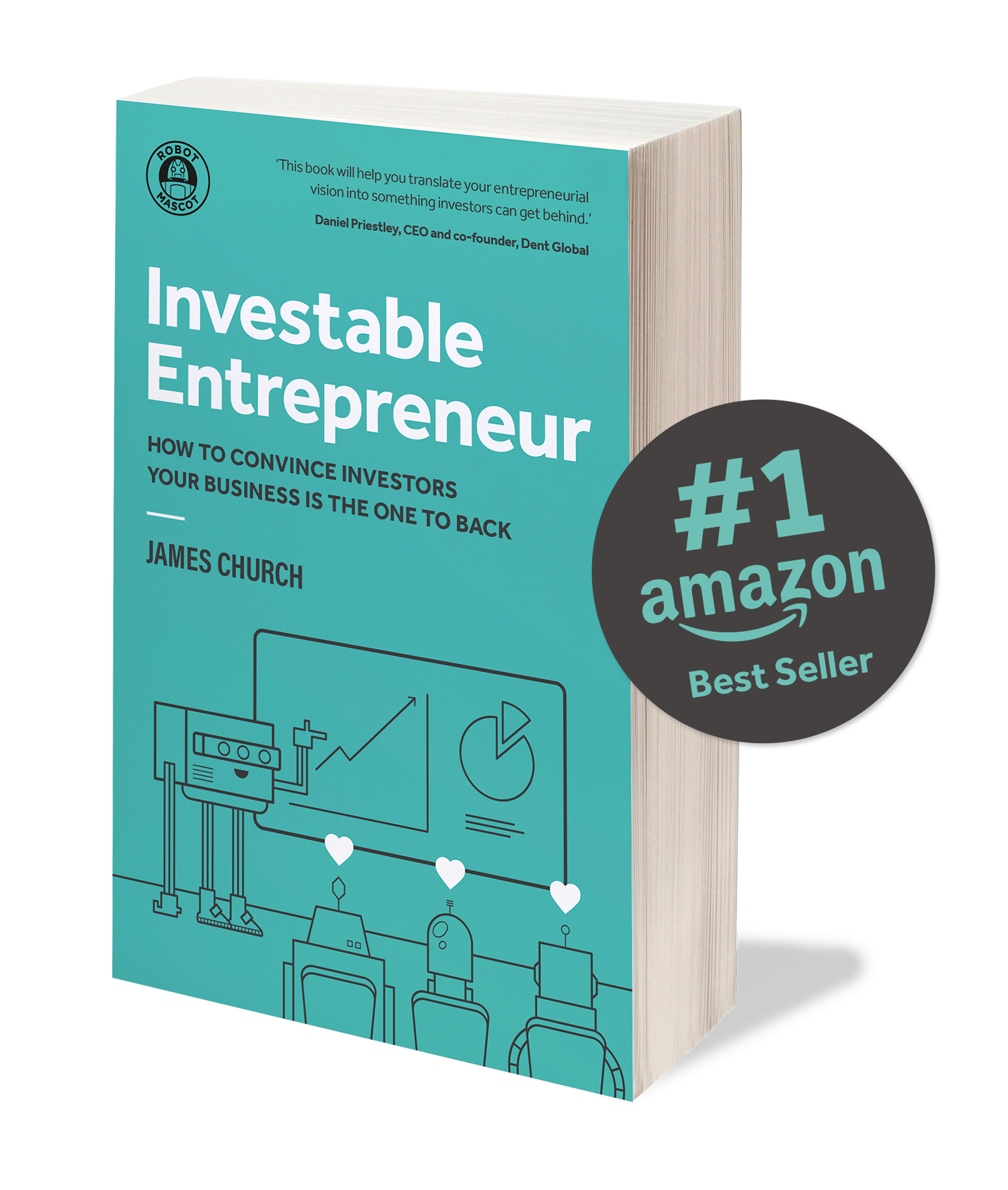
Want to know more about becoming an Investable Entrepreneur? You can download a free copy of Robot Mascot COO James Church’s bestselling book here.
READ: Debunking The Unicorn Myth: The Real Deal About Unicorn Startups

Learn how to convince investors
Investable Entrepreneur takes you through our winning methodology – the process we use to increase our client’s chances of raising investment by more than 30x.
“This book will help you translate your entrepreneurial vision into something investors can get behind.”
Daniel Priestley, CEO and founder, Dent Global and four times best-selling business author
Recent Posts


Keep up to date with what we’re up to via email



Copyright ©Robot Mascot Ltd. All rights reserved.
